
Tribometers and Coefficent of Friction
Serving Manhattan, Queens, Brooklyn, Bronx, Staten Island, Nassau, Suffolk, Rockland, Putnam, and Westchester.
Tribometer (sometimes called a slipometer) coefficient of friction measurements can be easily manipulated. Professional Engineers can determine the actual cause(s) of a slip, trip, and fall accident without relying on questionable coefficient of friction measurements. A Professional Engineer can also determine which Codes and Standards are violated, whether the hazard was created by the owner, whether a pedestrian injury is foreseeable, etc. The Professional Engineer also serves as an expert witness when necessary.
Pedestrians slip, trip, and fall on walkways, sidewalks, paths, parking lots, steps, and stairways for many reasons. Among the more common reasons are slippery surfaces, inattention, and surface or step defects where the pedestrian fell. Many pedestrians walk in places where there are defects, but not all slip, trip, and fall injuries occur because of negligence.
Slip, Trip, and Fall Accidents
This is not a criticism of the concept of coefficient of friction measurements or a comment on their value when properly used. This discussion applies to the widespread misuse of coefficient of friction measurements in evaluating slip and fall incidents. This does not apply to properly conducted slip-resistance measurements, used, for example, by flooring manufacturers.
Coefficient of friction is the ratio of the force of friction between two bodies and the force pressing them together. Static friction is the friction force when an object is not moving. Static friction is the force that prevents a block from sliding down an incline. Kinetic friction (also called dynamic friction) is the force when two objects are moving relative to each other. Generally, the kinetic coefficient of friction is less than the static coefficient of friction.
Coefficient of friction and slip resistance are often used interchangeably. Although they are related concepts, they are not identical. Slip resistance is what is being looked at in slip and fall incidents.
A slippery surface can cause a pedestrian to slip and fall. Years ago, a block of a known weight was dragged across the surface to measure the static slip resistance. However, slip, trip, and fall incidents occur when pedestrians are walking, so dynamic slip resistance appears more appropriate.
A Tribometer is a device used to measure tribological quantities. Tribology is the science of the interaction between surfaces in motion relative to each other. Tribology includes the application of the principles of friction, lubrication, fluids and fluid flow, and materials properties. In slip and fall incidents, human dynamics and human reaction to a perceived loss of friction play a significant role. Tribology includes mechanical engineering, materials science and engineering, fluid flow, physics, and chemistry. When analyzing slip and fall incidents using tribology, human factors must also be considered.
Click here for a history of tribology
Click here for a brief history of tribometers
Various methods of measuring dynamic slip resistance have been devised, and some have been accepted by Courts. In many cases, these measurements are made by self-proclaimed safety experts. The device used to make these measurements is often referred to as a Tribometer (sometimes called a slipometer), although there are other trade names by which a Tribometer is called. In some cases, Courts and Insurance companies have accepted these measurements blindly and used them to decide negligence or pay a settlement.
Tribometers do not slip and fall. Pedestrians slip and fall. It is important to remember this when looking at Tribometer slip resistance measurements. There are many problems with blindly taken dynamic slip resistance measurements:
There is no objective standard for measuring the coefficient of friction on existing steps, paths, walkways, floors, driveways, etc. Standards exist for measuring the coefficient of friction of manufactured flooring, but they have been misapplied to existing construction.
Many pedestrians do not know exactly where they fell, or where their foot was located at the moment they fell. The measured coefficient of friction can vary across different points on a surface.
The measuring devices often do not accurately reproduce the conditions when the pedestrian fell. The operator of the measurement device cannot accurately reproduce the motion of the person's foot before the slip, trip, and fall incident.
The coefficient of friction measurement can be influenced by the person taking the measurement. Based on surface irregularities, one can set up the Tribometer to show a higher or lower coefficient of friction.
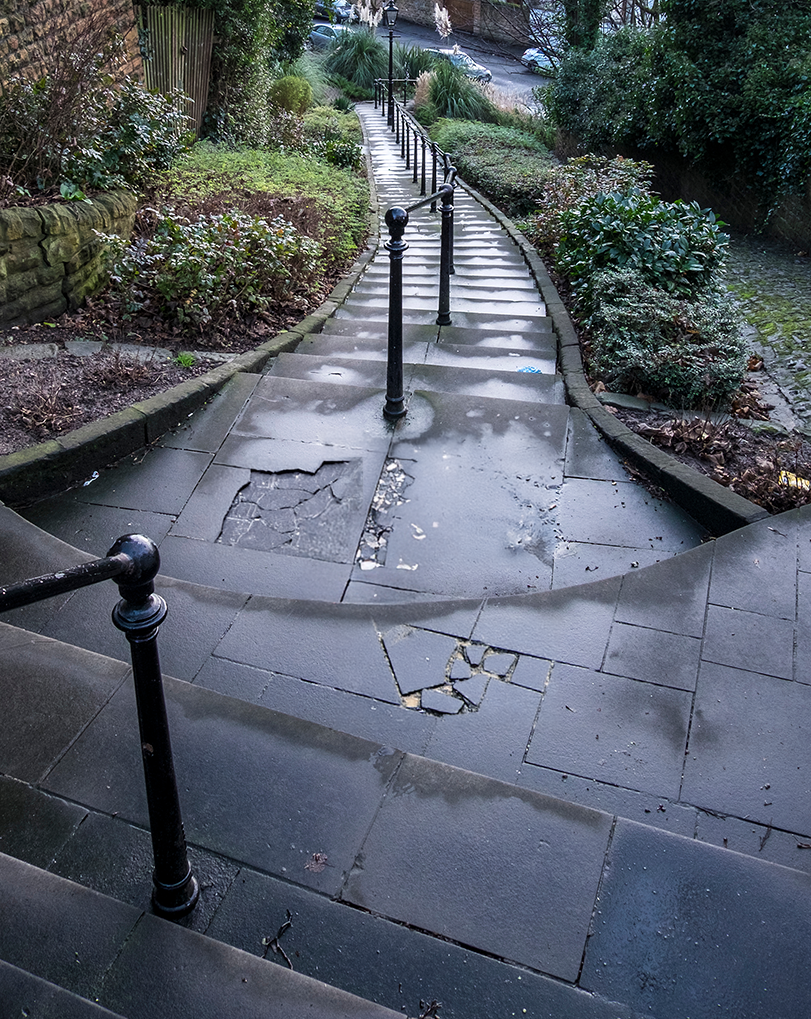
The image on the right shows three ways of taking a measurement on a the same curved surface. The arrows represent the location and direction of the force applied by the Tribometer:
The yellow arrow shows a coefficient of friction measurement taken on an upward-sloped surface. This measurement will be high because the Tribometer will hit the upward-sloped surface.
The orange arrow shows a coefficient of friction measurement taken on a downward-sloped surface. This measurement will be low because the Tribometer will slide on the downward-sloped surface.
The green arrow shows a coefficient of friction measurement taken on a flat surface. This measurement will be taken between the upward-sloped and downward-sloped surfaces.
The actual coefficient of friction depends on the pedestrian's footwear. Often, measurements are taken with a generic material.
Because of surface irregularities, the size of the contact area is critical. A pedestrian's shoe may contact different sections of a surface with varying slip resistance.
Many pedestrians slip on wet surfaces, so it has become a common practice to pour water on a surface and measure the coefficient of friction. The quantity of water and impurities in the water influences slip resistance. Spilling a cup of water on a surface does not accurately reproduce the conditions that existed when a pedestrian fell. All that is often determined is that a wet surface is more slippery than a dry surface.
The Tribometer does not accurately measure the coefficient of friction on a wet surface, even when the exact liquid and floor conditions are reproduced. This is because the dynamics of the Tribometer on a liquid surface are considerably different from those of a pedestrian's footwear.
Coefficient of friction measurements do not take into account hydroplaning-type phenomenon. (Hydroplaning and aquaplaning are generally reserved for the behavior of rolling objects like tires.) Hydroplaning occurs when a film of water builds up between a tire and the road, causing the tire to lose contact with the road. A similar phenomenon occurs when a layer of water separates a pedestrian's shoes from the floor.
Coefficient of friction measurements ignore the fact that walking is a feedback process. The human gait is a closed-loop feedback system, in which the brain adjusts based on expected and observed conditions. Measuring the dynamic slip resistance ignores the feedback part of a human's walk.
In some cases, measurement of the coefficient of friction has replaced an evaluation of the defects and cause of the slip, trip, and fall accident by a Professional Engineer. Just measuring the coefficient of friction without determining why a pedestrian slipped and fell is bad engineering.
Harold Krongelb, P.E., does not use questionable coefficient of friction measurements in evaluating the cause of a slip, trip, and fall injury. Instead, actual design or maintenance defects are reported. In many cases, these defects constitute code violations that provide objective evidence of the cause of the slip, trip, and fall injury.
